
If you are shopping for a feeding station, you will see options labeled “tilted.” A tilted dog bowl stand angles the bowls forward, changing how food and water sit inside the bowl and how your dog approaches the surface. Tilt can be helpful for certain eating habits, but it is not automatically better than a flat stand. In many homes, stability, height fit, and easy cleaning matter more than angle. Browse the collection here: Bowl Stands. For the full overview of choosing height, style, and setup, read the pillar guide: Elevated Dog Bowl Stand: How to Choose Height, Style, and Setup. For more posts, visit the category hub: Bowl Stands blog. Return to Home anytime to explore all collections. Related reading: If height is your main decision, start with Elevated Dog Bowl Stand Height Guide: A Practical Measuring Method.
Tilted dog bowl stand: what “tilt” changes
Tilt changes the “presentation” of food and water. With a forward angle, the near side of the bowl becomes slightly lower and the far side becomes slightly higher. This can change where food collects during meals, and it can change how far your dog has to reach into the bowl. In practice, a tilted dog bowl stand is trying to reduce the feeling of “digging” into a bowl, especially when the bowl is deep.
What tilt can improve in daily feeding
- Food access near the front: kibble may gather closer to the front as the bowl empties.
- Less head dipping for some dogs: the eating surface may feel easier to reach depending on height and bowl depth.
- More consistent eating rhythm: some dogs pause less if they do not need to chase kibble around the bowl.
What tilt does not solve
- Unstable stands: angle cannot fix a base that slides on tile or hardwood.
- Wrong height: if the stand is too high or too low, tilt will not create a comfortable posture.
- Fast eating: tilt does not necessarily slow intake (a slow feeder may be more relevant).
If your main goal is steadier bowls and a defined feeding zone, a flat elevated stand may already solve the problem. For a broader decision framework, return to the pillar: Elevated Dog Bowl Stand: How to Choose Height, Style, and Setup.
Tilted dog bowl stand: posture and comfort checks
The fastest way to decide whether a tilted dog bowl stand helps your dog is to watch posture and “meal behavior” over several normal meals. Look for calm, steady eating and a neutral stance. If your dog looks like they are reaching, bracing, or dropping food more often, tilt may be working against you.
Comfort cues that suggest tilt may help
- Hesitation with deep bowls: your dog pauses or noses around, as if the bowl feels hard to access.
- Chasing food to the edges: your dog repeatedly pushes kibble around and seems frustrated near the end of meals.
- Mess at the front edge: some dogs spill less if food naturally sits closer to the front (depends on bowl shape).
Comfort cues that suggest tilt may not help
- Increased spilling: angle can shift water toward the front edge, increasing splash in some setups.
- Awkward stance: your dog widens their front paws or braces during eating.
- Food dropping: kibble falls out more often, especially with enthusiastic eaters.
Simple at-home fit test
Before buying, you can mimic tilt by placing a thin, stable wedge under the back of a bowl on a mat and observing three meals. If the dog eats more smoothly with less “chasing,” tilt may be worth trying. If spills increase, prioritize a flat setup with a better mat and bowl depth.
Bowl depth, splash control, and mat pairing
Bowl depth and water behavior matter more with tilt than most owners expect. A shallow bowl may not change much when angled. A deeper bowl can change noticeably, especially with water. If your dog is an enthusiastic drinker, tilt can direct water closer to the front edge where splashes happen. That is why a tilted dog bowl stand is often best evaluated as a system: stand + bowls + mat + placement.
Bowl depth: what to check
- Deep bowls: tilt may improve food access as meals finish, but can increase water movement.
- Wide bowls: can reduce crowding for dogs with broader muzzles and may reduce dropping food.
- Bowl fit in the stand: bowls should sit snugly so they do not rattle or shift with each bite.
Splash control and mat pairing
A mat is not just for aesthetics. It protects flooring, improves grip, and defines the feeding zone. With tilt, a mat becomes even more important because drips and splashes may concentrate near the front. Choose a mat that is slightly larger than the stand footprint so splashes land on the mat, not the floor.
Placement for steadiness
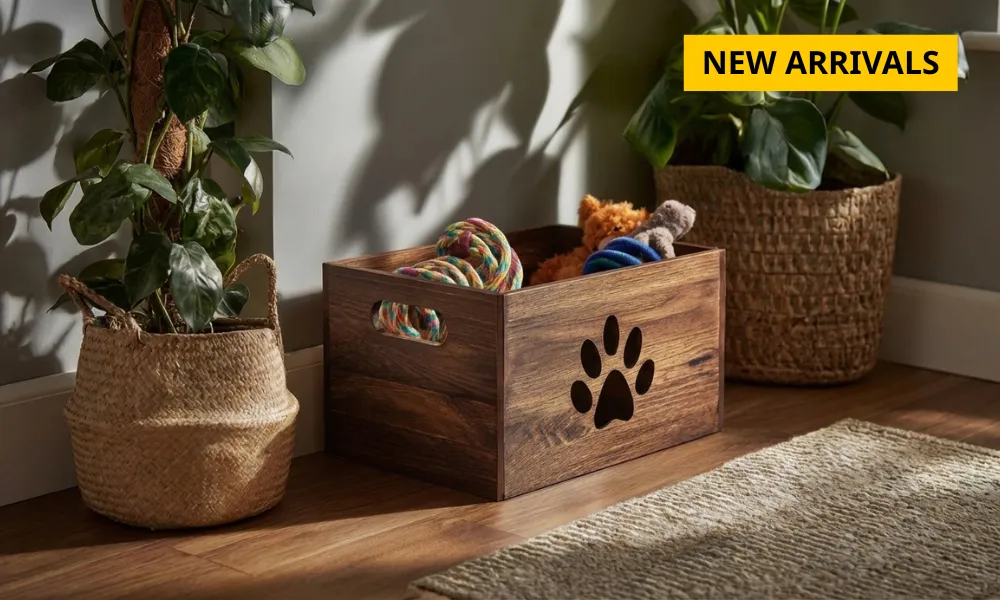
Place the stand near a wall or in a corner-adjacent location so your dog is not in a traffic path. This improves calm feeding and reduces accidental bumps. If your feeding area becomes cluttered with toys, cleanup gets harder and the station feels chaotic. A nearby storage solution helps: Pet Toy Storage Boxes. If you are still deciding on height, use this measurement method: Elevated Dog Bowl Stand Height Guide: A Practical Measuring Method.
When to choose flat vs tilted stands
Many households start with a flat stand because it is predictable and simple. Tilt becomes a more targeted choice when you have a specific issue you are trying to solve: food access in deeper bowls, certain eating habits, or preferences that show up consistently in your dog’s routine.
Choose a flat stand if
- You want the simplest setup with fewer variables to troubleshoot.
- Your dog already eats smoothly from a standard bowl without chasing food.
- Water splashing is your biggest issue (tilt can increase splash in some homes).
- You are still working out the correct height and want a straightforward baseline.
Choose a tilted dog bowl stand if
- Your dog regularly struggles with deep bowls and seems to “dig” for food near the end of meals.
- You have tested a slight angle at home and seen calmer, steadier eating.
- You can pair the stand with the right bowl depth and a mat that contains splashes.
- Your stand placement is stable and out of traffic flow.
What about adjustable vs fixed?
If your household needs height flexibility, decide that first. Adjustable and fixed stands can come in flat designs, and some may also offer tilt features. Start with stability and fit, then add features only if they solve a real problem. Ready to explore options? Browse: Bowl Stands. Return to the pillar guide: Elevated Dog Bowl Stand: How to Choose Height, Style, and Setup. Visit the Bowl Stands blog for more posts, or go back to Home. If you have health-related concerns, discuss feeding setup changes with your veterinarian. For questions about bloat discussions, see: Elevated Dog Bowls and Bloat: Questions to Discuss With Your Vet. Internal links included: Bowl Stands, pillar guide, Bowl Stands blog category, Home.